


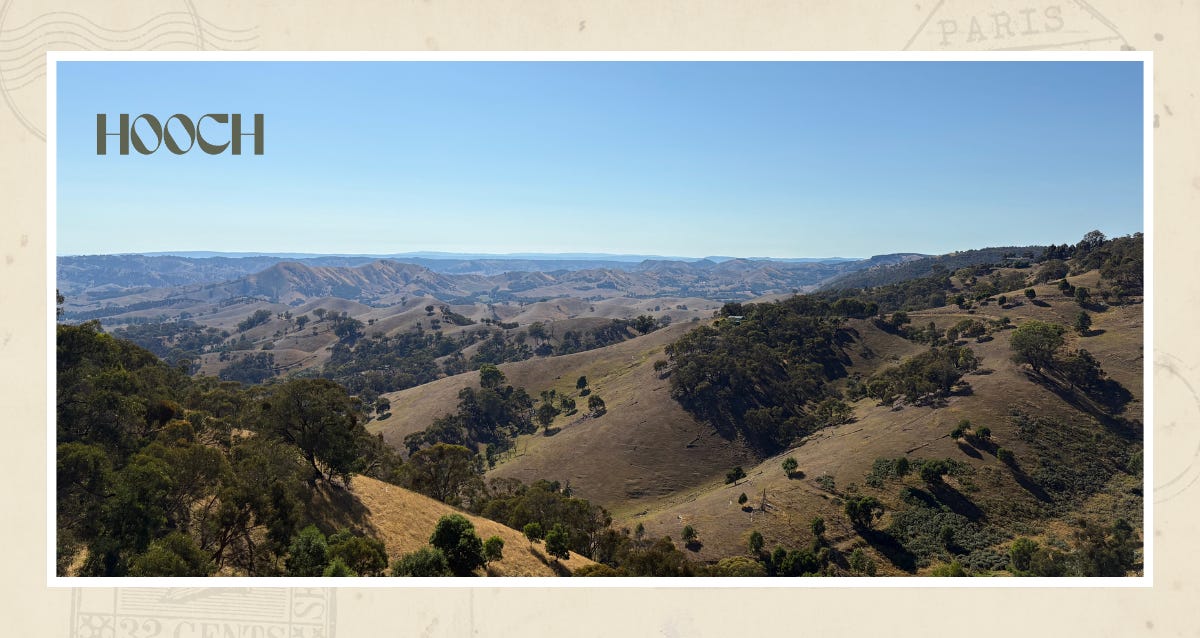
I pretty much booked Australia on a whim.
That is the cleanest way to say it now, though at the time it did not feel clean at all. It felt like a leap. It felt like pressing purchase on a flight before I had the full map of the year ahead. It felt like trusting verbal confirmations from clients, trusting the shape of work that had not yet hardened into contracts, trusting that the money would come, trusting that the world would hold, trusting that I was allowed to want something before I had earned perfect certainty.
I booked the trip in the middle of November 2024. Less than six weeks before I would leave Dublin, to land in Melbourne on Christmas morning.
There is something psychologically confusing about flying over Christmas. Maybe it is the way airports feel both full and abandoned. Maybe it is the way everyone around you seems to be moving toward something familiar while you are moving away from it. Maybe it is the strange permission that comes with being suspended between time zones while the rest of the world continues with dinner tables, wrapping paper, family arguments, weather reports, old traditions, and ordinary expectations.
I left Dublin in winter. I left in fleece and grey air and 30-degree temperatures. I landed in Australia in the summer. In light. In heat. Our landing felt less like an arrival and more like a complete atmospheric interruption.
By the time I got there, Christmas had already become something else. Not the Christmas I knew. Not the Christmas I had been raised around. Cold air was gone, the days were long, and none of the rooms or traditions felt familiar. It was disorientating. I had crossed more than geography. I had crossed out of the usual emotional architecture of the season entirely.
The reason I went was my great-aunt Mary. Gran’s sister.
She was turning eighty-nine three days after Christmas and had no idea I was coming. The plan was simple. Fly in. Surprise her. Attend the birthday celebrations. Meet the extended family I had only ever heard about in stories. Spend the better part of six weeks exploring Australia on my own.
That was the plan.
What happened was something else.


On Christmas morning, still hazy from sleep and lightly concerned about why everyone wanted her up so early, Aunt Mary came into the room and saw me. There was a moment before understanding landed. That tiny gap between seeing and knowing. Then the shock. Then the joy. Then the room changed.
I had imagined the surprise many times before I arrived, but there are some things you cannot rehearse your way into. I had never met many of these people before. They were family, but also strangers. Familiar in name and story, unfamiliar in body and presence. I had come prepared to be polite, grateful, and maybe a little outside of things. I had expected warmth, but I had not expected eagerness. I had not expected people to be as excited to meet me as I was to meet them.
That was the first surprise Australia gave me. Not the landscape. Not the heat. Not the scale of the city. Not even the strange miracle of arriving on the other side of the world on Christmas morning.
It was the feeling of being received.
The first week was not so glamorous. It was mostly sleep.
I have never known jet lag like that. I do not think my body understood what I had done to it. There were days when I had to go to bed at three in the afternoon, or four, or six, and then sleep straight through until one in the morning or three or six. I would wake in the dark with no real sense of where I was. I would stretch. Eat something. Go back to sleep. Try again. It felt like recovery.
That is the word I keep coming back to because it was not just travel fatigue. It was not just time-zone math. It felt physical and spiritual. As if the distance itself had forced my body to shut down all the systems I normally keep running. The old alerts. The old obligations. The old panic. The old habit of being available to every crisis in real time. Australia made that impossible.
The time difference did something to me. It created a distance I could not negotiate my way out of. There were only small windows of the day when a client could reach me and expect a real-time response. And, it showed me how rare of an occurrence this actually is. Outside of those waking windows, work was either something I leaned into or didn’t. A crisis was either still a crisis by the time I woke up, or it had already revealed itself to be noise.
That geography forced a prioritization I had not known how to choose on my own, too. For the first time in a long time, I was too far away to perform urgency at full volume. I was too tired to pretend everything mattered equally. I was too physically disrupted to maintain the same relationship to stress. “You’re a day ahead of whatever it is,” quickly became my mantra whenever the phone rang.
The distance did not solve anything. It did not make my life suddenly easier. But it changed the way my body received the demands placed on it. And inside that change, there was space. Space for excitement. Space for appetite. Space for curiosity. Space for constructive things. Expansive things. Space to let the day become more than a container for someone else’s need.
The first week, I slept, stretched, ate, and slowly came back to myself.
I also discovered chili scramble. This feels important to mention. Because not every resurrection is some grand celebration. Sometimes it is eggs.
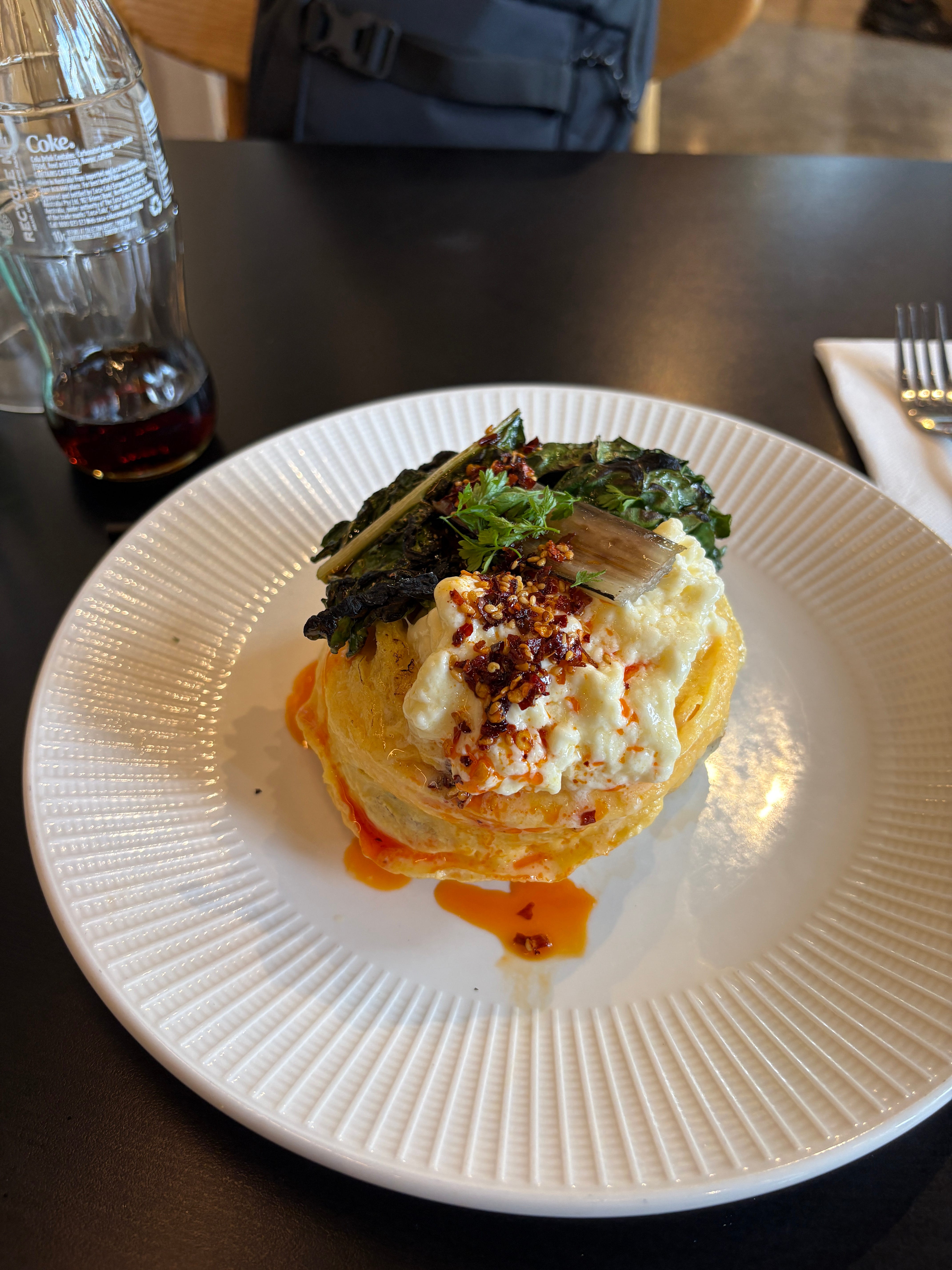
In Australia, chili scramble is everywhere, and it’s rarely careless. It is not a heap of eggs slopped onto a plate because someone needed to move breakfast along. It is plated with attention. Scrambled eggs, soft and generous, dressed with crispy heat, herbs, sourdough, and some form of brightness. That, paired with coffee, iced water, and an orange juice, is a breakfast that feels awake.
At Brick Lane, tucked near Flagstaff Gardens, I ordered eggs and found myself returning to life bite by bite. Heat in the mouth. Coffee on the table. The city outside already moving. My body still lagging behind the clock, but something in me beginning to catch up. I think the chili scrambles brought me back.
By the time I felt normal enough to leave the softened rhythm of recovery, my cousins Little John and Ash took me down the Great Ocean Road with Ash’s kids. I had spent weeks loosely planning Australia and somehow had not understood that this road existed in the way it does. I had not understood that a day could unfold with that much beauty in it and still feel unforced.
We stopped again and again. Viewpoint after viewpoint. Coastline after coastline. The sea opening in impossible blues. Cliffs dropping down into surf. Long bends in the road where the land seemed to keep revealing another version of itself.
The generosity of it is what stays with me.
Not just the landscape, though the landscape was astonishing. Not just the Twelve Apostles, which are no longer twelve but still hold the strange authority of a natural wonder. Not just the waterfall tucked into eucalyptus, the smell of the trees so aromatic it felt medicinal. Not just the first Australian iced coffee, made with vanilla ice cream instead of milk or half-and-half, which felt completely excessive and completely correct.
It was the fact that they wanted to take me.
They wanted to show me something. They wanted to spend the day doing something they knew I would love. Historical things. Adventurous things. Coastal things. Things I had built whole parts of my life around seeking.
That eagerness was almost trippy. I had not grown up inside this particular branch of the family. I knew names. Stories. Fragments. The kind of inherited knowledge that makes people feel both intimate and far away. But there I was, on the other side of the world, being driven along one of the most beautiful roads I had ever seen by people who had every reason to treat me like a guest and instead treated me like someone they had been waiting to fold in.
I was buzzing for weeks after that day. I am still buzzing a little, even now.
After the Great Ocean Road, something opened. I had slept enough. I had eaten enough chili scramble. I had begun to understand the heat. I had begun to understand the shape of the city. I had begun to feel the strange privilege of being far enough away from my familiar life that my familiar anxieties could not reach me with the same force.
So I did what I always do when a place starts to become real: I tried to live there.
I learned the routes. I walked the city. I made coffee stops part of my morning. I wandered through shops. I sat in parks. I let the tram system become less intimidating. I watched how people moved through the day. I tried to understand the pace, the posture, the casual rituals.
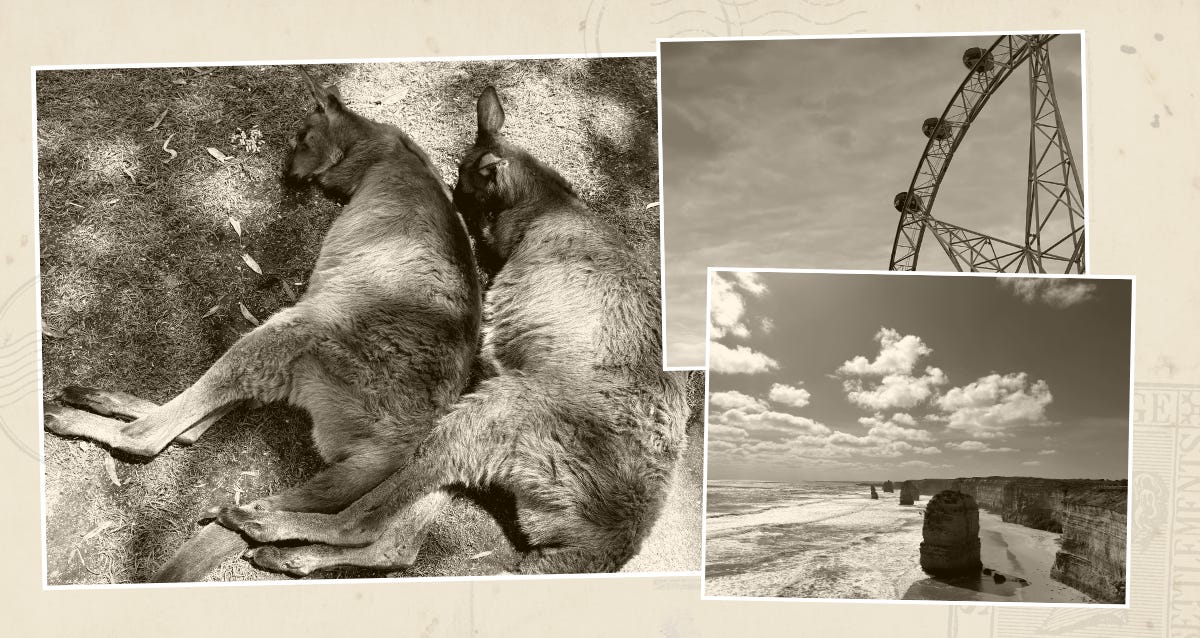
Melbourne was not what I expected. For some reason, I had imagined something smaller. More residential. Maybe a handful of skyscrapers and a lot of natural beauty around the edges. There was natural beauty, yes. But the city itself was enormous. Dense. Vertical. Alive. Dozens of skyscrapers. Millions of people. “Locals” by way of western Europe, Asia, America, and beyond. Tourists. Tennis players in town for the Australian Open. Workers. Families on their summer holidays. Students on their gap year. Everyone moving through peak summer as if the whole place had been turned up slightly louder.
I stayed at Nesuto Docklands, a serviced apartment building designed for longer stays, and it gave me exactly what I needed. A room with enough function to feel settled. Staff who paid attention. A base. Docklands was not where my heart ultimately landed, but it gave me the structure to arrive properly.
From there, the city became accessible. Melbourne’s central business district held me more than I expected. The range of it. The diversity. The public life. The shopping corridors. The laneways. The ease of falling into a coffee shop or a museum or a tram line or a park. There was a hum to it that I understood quickly.
I found Federal Coffee in the middle of Bourke Street and made it a mid-morning reset. Coffee. People watching. The ordinary pleasure of being briefly anonymous in a busy city that did not feel indifferent.
There are cities where anonymity feels like disappearance. Melbourne made anonymity feel like participation. You could be alone without being erased. You could sit with a coffee and watch the day move around you and still feel somehow inside the life of the place.
Family helped me see more than I would have seen alone. My cousin John, Lil’ John’s dad, took me to Sovereign Hill in Ballarat—an old gold-mining town where the early settlement story sits inside dust, costume, machinery, ambition, and that familiar human hunger for a better life somewhere else. Another day, John and his wife Loretta and her brother Stephen took me off-roading out to Craig’s Hut, an iconic wooden cabin perched in the mountains a few hours outside the city. Again, history and adventure. Again, people choosing to show me something not because they had to, but because they had listened closely enough to understand what might light me up.
I was not prepared for that kind of attention. I was not prepared for how emotional it would feel to have people I had just met make plans around my interests. Not vague plans. Not obligatory hospitality. Real plans. Roads. Museums. Mountains. Old towns. Coastal drives. Meals. Conversations. The kind of welcome that bypasses performance and lands somewhere deeper.
Melbourne felt like acceptance in a way I had not known before. The city gave me one kind of belonging. The family gave me another. And then, unexpectedly, strangers gave me another still.
I have a history of using dating apps as a way to meet people in new places. There are pros and cons to this approach. I know that. It can be messy. It can blur intention (both ways). It can create false intimacy or transactional closeness. But in Melbourne, something different happened.
Most people felt more grounded. Intentional. Physically present. That sounds simple, but it was not simple to me then. I was still in a re-explorative phase around my sexuality. Before leaving Philadelphia, I had met someone who made me feel, in a way that startled me, that I could imagine spending my life with a woman. Then I left. Ireland, Italy, Germany. Movement upon movement. City after city. I did not really lean into emotional intimacy during that stretch. I was traveling, yes, but also quietly holding something. Testing what I wanted. Testing what felt true. Testing how much of myself I was ready to let be visible.

In Melbourne, that testing became less theoretical. Sometimes someone wanted to show me a bar. Sometimes someone wanted to show me their favorite hike. One person wanted to help me understand public transit, so we rode trams through the city as if that was a perfectly reasonable way to spend time with someone new. Another bloke and I walked around Fitzroy one evening, then ended up lying in the grass of a local park as the sun went down, talking while bats moved above us.
That image has stayed with me. Not because it became something grand. Not because it resolved into romance. But because it represented a kind of ease I had not known to expect: Two men in the grass at sunset. No rush to define it. No immediate pressure to make it useful. No performance of hardness. Just bodies in a park. Conversation. Heat leaving the day. Bats circling overhead.
The strange intimacy of being beside someone while a city moves into evening around you. It disrupted something in me.
My expectations around male intimacy had been shaped by absence, guardedness, performance, tension, longing, and the long private work of figuring out what desire meant when it was not yet fully spoken. Melbourne did not solve that. A city does not solve a life. But it showed me something. It showed me that closeness could arrive through ease. That connection could feel grounded instead of frantic. That physical presence did not have to become immediate possession. That wanting could breathe.
For a few weeks, I had a routine.
That was when Australia clicked. Not at the airport. Not on Christmas morning. Not even on the Great Ocean Road, though that day lives in me as one of the great days of my life. It clicked when I stopped counting the trip and started inhabiting the days.
I had my own interests. My own routes. My own breakfast spots. My own coffee breaks. I saw Aunt Mary weekly. I made friends. I knew where to go when I wanted to work. I knew which neighborhoods pulled me in. I knew where I wanted to walk. I knew what kind of morning I could build.
At some point, I lost sight of the fact that I would have to leave. And, for the record, for anyone planning for nomadic existence, that is when a place becomes dangerous.
Not dangerous in the obvious sense. Dangerous because it starts making a claim. Dangerous because a life begins to take shape without asking permission from the life you already have. Dangerous because you begin to imagine ordinary things there. Groceries. Rent. A favorite table. A regular walk. A person texting you to see if you want to make the most of the time you have left, except the ache beneath that sentence is that the time is already measuring itself.
I remember trying to convince the bloke from Fitzroy that we should let whatever that was be what it was. To make the most of our time. To force ourselves to lean as far in as possible, even though I only had two weeks left in the city. Even though heartbreak was almost certainly guaranteed.
That is a difficult kind of honesty. Not because it asks for forever. Because it does not. It asks for presence without guarantee.
And maybe that is what Australia kept teaching me. Presence without guarantee. Joy without certainty. Belonging without ownership. A life glimpsed before it was secured. All the while, underneath the beauty, there was tension.
I had booked the trip on faith. I had verbal assurances that work would continue. I had reason to believe the year ahead was stable enough. But while I was in Australia, I learned that my biggest client at the time was losing their business after a period of gross negligence, and that the long-promised past-due balance on our earlier retainer agreement might not be coming at all.
By the time I was preparing to leave Melbourne, parts of my life felt suspended.
I was not walking around in a constant state of panic. That is important to say because it would be easy to flatten the story into crisis. It was not crisis in the obvious way. The trip had done something to my nervous system. The distance had changed how much urgency I could absorb. But the information was there. The uncertainty was there. The possibility that the security I had worked so hard to build might not be as secure as I had believed.
And still, I chose to live inside the trip. I am proud of that now. I am proud that I did not let uncertainty steal the whole thing from me. I am proud that I let myself be there. Fully. Not perfectly. Not without fear. But there. On the road. In the parks. At breakfast. On balconies. In museums. With family. With strangers. With the version of myself that had enough space to feel excitement again.
That feels connected to the moment I am in now.
I have been trying to align myself only with relationships and projects that feel secure, mutual, and in service of something real. Not because everything must be safe. Not because risk is bad. But because uncertainty created by negligence is different from uncertainty created by growth. One drains you. The other asks something of you.
Australia was risk. But it was not reckless. It was a leap toward life.
When it came time to leave Melbourne, I cried while packing. I was not sobbing. This wasn’t a total collapse. Just tears. Happy tears, mostly. Gratitude moving through the body with nowhere else to go.
I was texting with cousins in Ireland, trying to explain what had happened over those weeks. Trying to unpack the road ahead. The stops between Melbourne and Sydney. The days still to come. The return that would eventually follow.
And then I realized I did not really want to go back to Ireland either.
That realization complicated things. Ireland had been important. Italy had been important. Even that brief albeit long weekend in Germany had been important.
Each place has shown me something, stripped something from me, restored something in me, and redirected something around me. But Melbourne had done something different. Melbourne had not only given me experience. It had given me evidence.
Evidence that I could belong somewhere in a way that did not require shrinking.
Evidence that family could be expansive.
Evidence that male intimacy could feel warm and grounded.
Evidence that a city could hold ambition and softness at the same time.
Evidence that if I had just a few more weeks, a life might begin to take shape.
That was the unfinished business. Not a missed museum. Not a restaurant I did not get to try. Not a neighborhood I failed to fully explore.
A life.
I left Melbourne and drove toward Sydney by way of the southeastern coast. Originally, I had planned to move through that stretch in three to five days. I had expected Sydney to be the larger destination, the big finish, the iconic end. But Aunt Mary advised me to avoid spending too much time there and to give the coast as much room as possible. And, Aunt Mary is never wrong.
I am grateful I listened. I stopped first in Lakes Entrance, then Merimbula, then Batemans Bay. Motel rooms. Coastal roads. Water appearing and disappearing beside me. That particular kind of road-trip solitude where you are alone, but not lonely exactly. Just in motion. Your life packed into bags. Your next room waiting somewhere ahead. Your mind moving through everything that has happened and everything you do not yet know how to name.
Batemans Bay became a five-day-long slow-motion exhale.
For some reason, I remembered it as longer. Until writing this, I would have told you I was there for more than a week. Maybe that is because it expanded. Maybe some places do that when they give your nervous system exactly what it needs.
My room had two balconies overlooking one of the most beautiful natural marine spaces I have ever had daily access to. I could sit there and feel my lungs swell and release with the tide outside my window. That is not metaphorical in the decorative sense. It felt physical. Breath matching water. Body remembering how to release.
After Melbourne’s intensity, Batemans Bay gave me a different kind of belonging. Not social belonging. Elemental belonging.
Water. Air. Light. Tide. Balcony. Quiet.
I had other cousins nearby, about half an hour south, and I connected with them too. That mattered. (Partially because they brought me to the best Beef Basil Stir-fry known to man, and also the kinship.) But much of Batemans Bay was solitude in the best sense. Solitude without abandonment. Solitude with a view. Solitude that lets the body digest what the heart has been too busy receiving.
There was no romance in it. But there was a meeting that felt important: I met a local yoga teacher who seemed, in some quiet way, like a future version of myself. He had trained locally, earning his yoga teaching certification with a local practice, but he was also well-traveled. He moved between Australia, Europe, and Asia, personally and professionally. He had integrated movement, work, travel, place, and practice into a life that did not require the old division between ambition and freedom.
I remember thinking, I want to be like this guy. In this place. Not literally him. Not exactly his life. But the integration. The ease of it. The evidence that a person could build a life around movement without becoming ungrounded. That travel could be more than escape. That professional life could stretch across geography. That the body could be part of the work, not an afterthought to recover from after the work had taken everything.
Batemans Bay gave me that image: A man by the coast. Trained in something embodied. Connected to a local place. Moving through the world. Returning to water. Not frantic. Not endlessly proving. Still building. Still participating. Still free.
I had been thinking about all the ways I might integrate travel into my personal and professional life during the drive, and then there he was. A version of the question, standing in front of me.
That is one of the stranger gifts of travel. Sometimes the landscape gives you beauty. Sometimes the people give you welcome. Sometimes a stranger gives you a model.
After Batemans Bay, Sydney was hard. I spent three nights and four long days there over the Australia Day holiday. The city was packed. The sun was brutal. Crowds pushed me away from the major museums and tourist sites I might have otherwise tried to see. I mostly roamed the streets, sat in parks, and read.
Sydney did not hold me the way Melbourne did. But maybe it did not need to. By the time I arrived, I had already received the trip’s central offering. Sydney became contrast. A reminder that not every famous place becomes intimate. Not every destination asks to be claimed. Sometimes a city is impressive and still not yours.
That realization made leaving easier.
If Sydney had opened the same way Melbourne had, departure might have been unbearable. Instead, Sydney gave me heat, crowds, distance, and a quieter ending. I sat in the park and read. I let the days pass. I let the country begin to loosen its grip. Still, Australia as a whole stayed with me.
People often ask me, of all the places I have been, which was my favorite. I can see the question forming as soon as I mention Australia. The lights go on. They hold back just long enough for me to rattle through the list, but I can feel what they expect. They expect Australia.
For a long time, I did not say that. I would say, “Everywhere was different.” And that was true. Everywhere was different from the life I had been living in Philadelphia. Every place carried its own weather, its own lesson, its own version of aliveness. Ireland gave me one thing. Turin gave me another. Florence another. Verona another. Munich another. Melbourne another.
It felt too simple to name a favorite.
Then my mother was surprised when I did not immediately say Australia. “I thought you’d say Australia,” she told me.
Her surprise surprised me.
But maybe she could hear something I had not fully admitted. Maybe she had noticed the way I lit up when I talked about it. Maybe the evidence was there in my voice before it was there in my conclusions.
There is something in that. The way I almost cannot believe I did it at all. The way I still think about the heat of Christmas morning, Aunt Mary’s face, the cliffs on the Great Ocean Road, the bats over Fitzroy, the balcony in Batemans Bay, the chili scramble, the iced coffee with ice cream, the cousins who wanted to show me their version of the country, the room in Docklands where I cried because I had been so grateful to belong somewhere so quickly.
Australia did not become my favorite because it was perfect. It became important because it gave me a picture of the life I actually want to build.
A life with space. A life with movement, but not constant escape. A life where work does not get to colonize every hour of the day simply because technology makes me reachable. A life with chosen routines in cities that make me feel awake. A life with coffee shops and coastal roads and museums and family and physical presence and bodies in parks at sunset. A life where ambition is still present, but not at the expense of breath. A life where I can be both rooted and roaming. A life where the geography itself helps me remember what matters.
That is what Australia did to me. It took me far enough away from the familiar that I could hear a different rhythm. Then it placed me among people who seemed genuinely glad I had come. Then it showed me roads and coastlines and rooms and meals and conversations that made me feel, maybe for the first time in a very long time, that expansion did not have to be lonely.
I went to Australia to surprise Aunt Mary for her eighty-ninth birthday.
I did do that.
But Australia surprised me back.
It showed me that I could be received. That I could recover. That I could want more. That I could survive uncertainty without handing my entire emotional life over to it. That the future might not arrive as a five-year plan. It might arrive as a morning in a new city when you realize you know where to get breakfast. As a cousin, asking if you want to see something beautiful. As a stranger lying beside you in the grass while bats move through the evening sky. As a balcony where your lungs finally match the tide.
And once a place shows you that, you do not really leave it cleanly. You carry it forward. Not as nostalgia. Not only as nostalgia but as evidence.
Where You’d Find Me in Melbourne
Nesuto Docklands
80 Waterfront Way, Docklands VIC 3008
Nesuto Docklands was my base in Melbourne, and it worked beautifully for a longer stay. It is a newer serviced apartment building, which meant I had the structure and function of a furnished apartment without being fully on my own. The staff were excellent. Attentive, accommodating, and quietly aware of the details that make a longer stay feel easier.
Docklands was not ultimately the neighborhood I fell hardest for, but it gave me a steady place to land. If you are visiting during the Australian Open, it is especially practical. The location is relatively close to the tennis activity, and during my stay it was frequented by some incredible players. There was something surreal about recovering from jet lag in the same building as people whose bodies were tuned for peak performance.
Brick Lane
33 Guildford Lane, Melbourne VIC 3000
Brick Lane is the breakfast spot that turned me onto chili scramble. It sits close to Flagstaff Gardens, which makes it especially good for a slow morning. Breakfast first. A walk after. No need to rush the order of things.
Their “Eggs Any Way” was the beginning of my love affair with the Australian breakfast plate. I had been so tired that first week, so physically scrambled by the travel, and this was one of the places that helped me return to myself. Coffee, heat, eggs, a well-plated breakfast, the city waiting outside.
Flagstaff Gardens
309-311 William Street, West Melbourne VIC 3003
Flagstaff Gardens became one of those simple city pleasures. Not a grand destination. Not something you need to over-plan. Just a good place to walk after breakfast or sit for a little while when the body needs green space.
I think every good city needs places like this. Small resets. Breathing spaces. Public rooms without walls.
Federal Coffee
350 Bourke Street, Melbourne VIC 3000
Federal Coffee became my favorite mid-morning break in the CBD. It is centrally located, which means there is excellent people watching, especially if you have been shopping or wandering through the city.
I liked it because it felt easy to fold into a normal day. Not precious. Not overly designed around being discovered. Just coffee, movement, and the pleasure of sitting inside the pulse of the city for a while.
Melbourne Museum
11 Nicholson Street, Carlton VIC 3053
The Melbourne Museum is an easy recommendation, especially in midsummer when the heat starts to feel relentless. It offers the practical gift of air conditioning, but also the deeper pleasure of stepping into a city’s memory and structure for a few hours.
It is a strong midday break if you are trying to balance outdoor wandering with something slower and more interior. I found it grounding in the way good museums can be. A reminder that every place has layers underneath the version tourists usually see.
National Gallery of Victoria
180 St Kilda Road, Melbourne VIC 3006
The National Gallery of Victoria is another must-visit if you need a summer-day pause. It is spacious, cooling, and generous. A place where you can let the day soften around art.
I would not over-program it. Go when the heat is too much. Go when the city feels too loud. Go when you want to be surrounded by form, color, rooms, and quiet movement.
The Conservatory at Fitzroy Gardens
298 Wellington Parade, East Melbourne VIC 3002
The Conservatory inside Fitzroy Gardens is one of those places that feels small but memorable. It is worth seeing because it offers a slightly different register of beauty. Held, cultivated, floral, calm.
Fitzroy Gardens itself is also worth time. Melbourne has a way of giving you dense urban energy and then, suddenly, somewhere green enough to change your pace.
Industry Beans
70-76 Westgarth Street, Fitzroy VIC 3065
Industry Beans in Fitzroy was one of my favorite places to work from. It is a trendy roastery in a former warehouse, with innovative brunch options and strong house blends. It has the feeling of a place where people are doing things, making things, building things, thinking through things.
For me, Fitzroy was the neighborhood that felt most aligned. If I returned to Melbourne for a longer stretch, I would look seriously at Fitzroy or neighboring Collingwood. There was a creative intelligence to the area that made sense to me. Cafes, shops, parks, texture, a bit of edge, a bit of ease.
Fitzroy and Collingwood
Neighborhoods northeast of Melbourne’s CBD
Fitzroy was my favorite centralized neighborhood in Melbourne. Collingwood, right next door, also had the kind of atmosphere I would want to explore more deeply on a return.
These are the places where I could most clearly imagine a life taking shape. Morning coffee. Work blocks. Evening walks. A loose social rhythm. Interesting shops. Good food. People who seem to be building lives with intention but not sterility.
If Docklands gave me a practical base, Fitzroy gave me the emotional picture.
Country Road
Multiple locations in Melbourne
Country Road was a pleasant surprise. A lot of retailers in Melbourne carried familiar American or European brands, but Country Road felt distinctly Australian in a way I appreciated. It is still fast fashion adjacent, but the quality and design were better than I expected.
For men especially, they make a great short and a strong carryall. I bought an oversized adjustable tote there that I still use regularly, and people stop me all the time to ask where it came from. That is usually a good sign.
Great Ocean Road
Day trip from Melbourne toward the Twelve Apostles
The Great Ocean Road deserves its own post, and I may eventually write one. It was one of the most unforgettable days of my life.
If you have the chance to go, go slowly. Stop often. Let the road be the point, not just the destination. The coastline is astonishing, but so are the smaller moments. Eucalyptus in the air. A waterfall tucked away from the road. The strange joy of an Australian iced coffee made with vanilla ice cream. The feeling of coming around another bend and realizing the landscape still has more to give.
The Twelve Apostles are worth seeing, even if the number has changed. But the day is bigger than that. It is road, water, cliffs, conversation, and the generosity of whoever is willing to experience it with you.
Torquay
Surf Coast, Victoria
Torquay was one of my favorite places in all of Australia. We passed through it briefly during the Great Ocean Road day, and I went back two or three times before leaving Melbourne.
It is a huge surf location, but it did not feel overcomplicated to me. There is a small commercial corridor, then mostly you and the water. People seemed to be there simply to be there. To surf. To walk. To sit. To exist near the sea without making too much of it.
It had that rare quality I always notice in beach towns I love. A sense that life has been organized around the water, not merely placed beside it.
Sovereign Hill
Bradshaw Street, Ballarat VIC 3350
Sovereign Hill is an old gold-mining town in Ballarat, and it gave me a window into the history of early settlement and the hope that pulled people toward new land. It is immersive, historical, and interesting in the way reconstructed places can be when you let yourself take them seriously.
I went with my cousin John, which made it more meaningful. Some places are better when seen through family. You are not only learning the history of a country. You are learning what someone thought was worth showing you.
Craig’s Hut
Mount Stirling, Victoria
Craig’s Hut was part of an off-roading day trip with cousins, and it gave me another version of Australian landscape. Less coastal. More rugged. Mountainous. Expansive in a different register.
The hut itself is iconic, perched in a setting that feels almost cinematic without needing to be exaggerated. The drive, the elevation, the remoteness, the company. All of it made the day feel like a different chapter of the same welcome.

