


When I was small, someone gave me one of those novelty calculators. The almost prehistoric kind with wooden beads strung across a frame. You push them from one side to the other. I don’t remember ever using it the way it was intended. (Believe it or not, Generation Alpha, we had calculators at that time.) What I remember is holding it and thinking: that’s me. One bead on a wire, bouncing between two ends of the same street with force.
On one end was my dad’s house.
On the other end was Gran’s.
I spent a lot of years on that wire. Tax on one side, token on the other. Accredit it to my old (tired) soul, but the difference was clear to me even then. I’ve always been able to understand things without even having the language for them.
My Gran’s house was the safe end. It was the place where I exhaled. The kind of place that has a particular weight when you’re a child. The smell of it. The quiet of it. The sense that nothing bad has jurisdiction there. She was the reason for that. She was, for a long time, the gravitational center of an entire world.
When my dad moved us to another town, that center began to fold. There was no single moment to point to. Life was just moving on. The street just got further and further away. And then, slowly, so did everyone on it.
The neighbors. The church. The people who had known me since before I knew myself. The year after my dad moved, I transferred into a different school system in a different county altogether. By the time those two things had settled (the move, the school) the connections were gone. Not because I had let them lapse or chosen something else. They were taken with the relocation, the way furniture disappears into a moving truck and you don’t think about it until the room just doesn’t look right.
I came back to that street at eighteen, during college. To move in with Gran and Pop-Pop for a stretch of years that I’m still grateful for. But six years is a long time at that age. Long enough that the people you grew up alongside have become strangers with familiar faces. Most of my friends weren’t around anymore. The street felt the same and nothing about it was. It reinforced something I have always known to be true, that you can return to a place and still find it inaccessible.
What I also learned, though not right away, was that I had been told I didn’t belong there. Not just made to feel it - actively told it. The people on that street, in that community, in that church belonged to someone else. They were “their family,” “their community.” Those phrases staked into the ground to establish who had seniority, who was deserving of loyalty, who was the rightful heir to those relationships. The message was efficient: you are a visitor here. Act accordingly.
I’ve honored that. I’ve let him have it. I’ve seen some of those people at weddings over the years. I saw a lot of them at Gran’s funeral. And then I didn’t hear from them again, and that was fine, because I had stopped hoping and expecting for anything different.
What I didn’t expect was how much I’d still think about the place itself.
My mom called a few weeks back with a little news from that corner of the world, updates from people in our orbit. Some were Gran’s people. Our neighbor. She always relays these updates with a unique sense of giddy surprise.
It reminded me that I had been sitting with some regret since Gran passed. I told her about it: There was a man Gran spoke of often. A priest, from our church at the top of the street, who had been an important presence in her later life. He deepened her faith. He saw her through hard seasons. He became, in the way of certain rare friendships, someone she genuinely loved.
He left the church in the nineties. For a higher and truer calling. For love, the story went. After that, he was gone from the directories, the archives, the publicly traceable record of a life that I consider myself somewhat of a sleuth at uncovering.
Gran had hoped, I think, that they’d find each other again. The way you hope for things without saying them directly. I tried but they never did.
After she died, I decided I would try to find him again. Not to reach out necessarily. Just to know. To complete something I felt she would have wanted completed. I went back to the Archdiocese directories and whatever else I could find online. Still nothing.
My friend Megan suggested the church secretary. She was the only person who might know the name. She might have filed the paperwork. Might remember the face. Might have kept a record of a man who quietly left a life behind.
I was resistant. Not rationally. Energetically. I knew that reaching back into that corner of my history, even for something this small, could activate a whole network. That’s how those things work. You pull one thread and the room rearranges.
The night I messaged the secretary on Facebook, a family friend (someone I hadn’t spoken to in years, someone orbiting the same quiet galaxy) reshared an old photo of me. No real context. Just the photo, surfaced and put back into circulation.
I wasn’t surprised. I was confirmed. This is how it goes when you go back there, even at a remove. But I went anyway, because it mattered.
The secretary remembered. She gave me the name. And eventually, I found him.
Over the last thirty years, he has built a life that looks, from the outside, like everything my Gran would have wanted for him. Community. Depth. A sense of having arrived somewhere that fits. And the all-encompassing love that comes with that. She always spoke of him with quality in her voice. With a particular warmth in her tone, reserved for people she would have watched struggle toward something good. She wanted his happiness the way you want things for people you’ve seen be brave.
It gave me peace, seeing it. More peace than I expected.
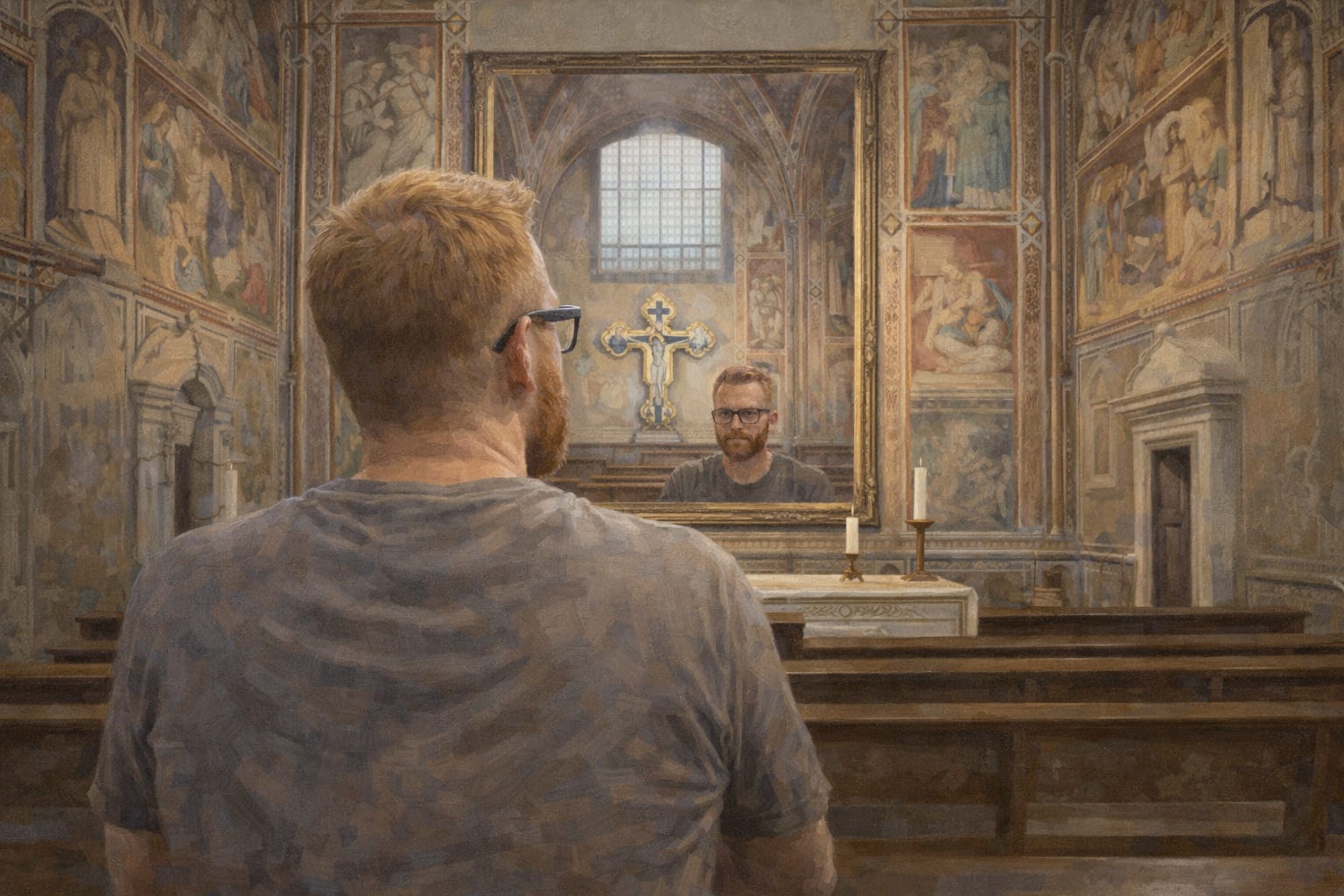
I’ve been trying to understand why going back there, even remotely, carries so much weight. I think I named it once, in a different conversation: a place I lost. That street. Those people. That church. They were the last place where the life I was supposed to have still looked possible. The last reach toward something that felt like hope and faith and community before those things became inaccessible. I wasn’t ready for them to become inaccessible. I don’t think any kid is.
But here’s what occurred to me recently: Gran left that street too.
She moved, later in her life, and hoped to return and never did. She carried the same world I carry. The same cast of characters, the same gravitational memory of that place. And, she never got back to it either.
There’s mutual grief in that. I don’t know why I didn’t see it sooner. Maybe because she held it so lightly. Maybe because she held everything lightly by the end, the way people do when it’s decided that where we are matters more than where we’re going.
She raised me in the image of a man who traded certainty for love and built something real from the pieces. I don’t know if she did that consciously, or if that’s just who she was. Someone who recognized a certain kind of life when she saw it, called it out, pointed toward it, and drew a map.
I wonder sometimes if the mirror I keep finding myself in front of is one I’ve propped up myself, or one she gave me. I don’t know. I’ll never know. Those are just the kinds of things that nobody is supposed to resolve.