


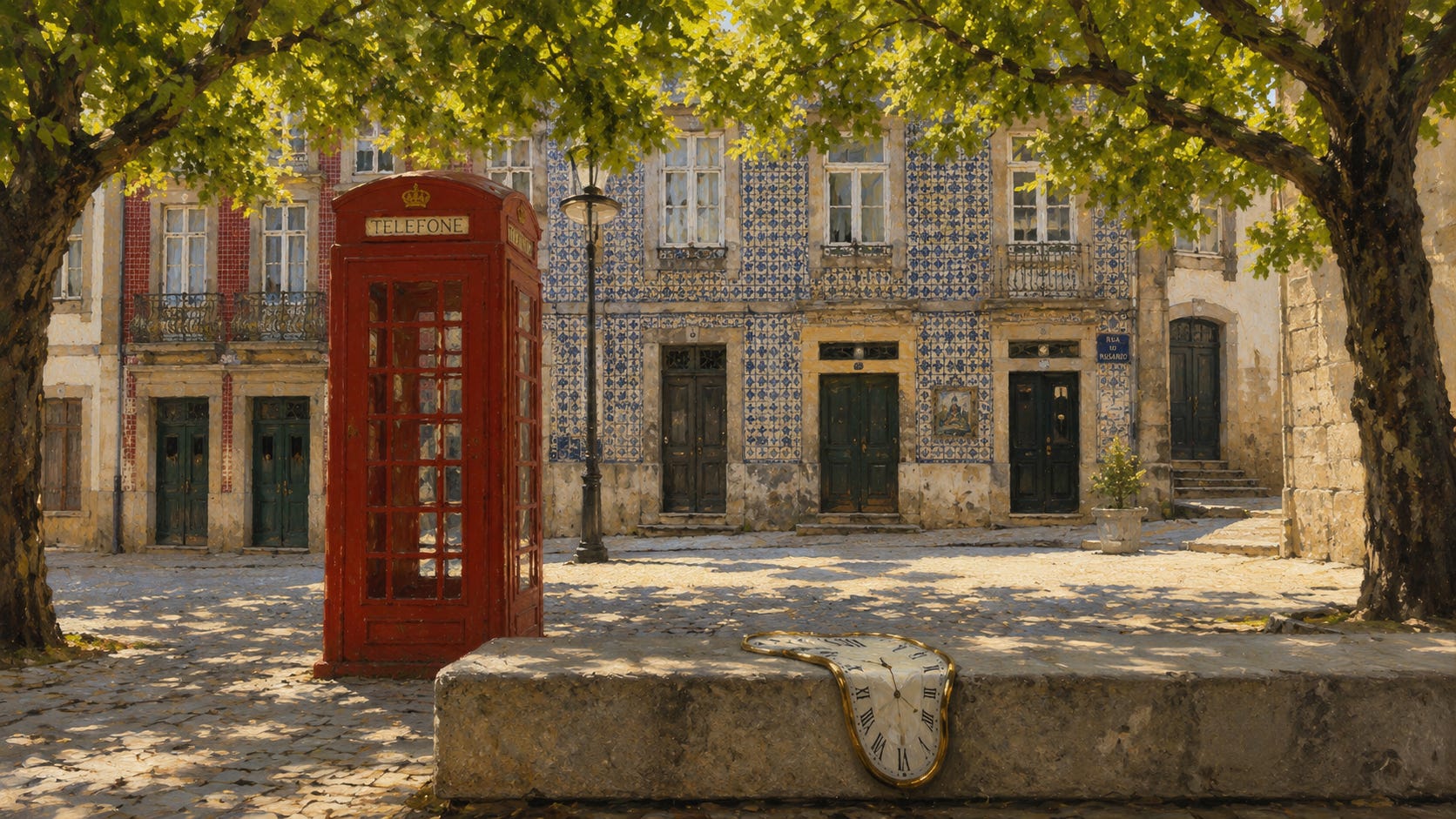
You don’t realize how much anticipation you’re carrying until you find yourself somewhere that doesn’t ask for it.
For a long time, I mistook anticipation for responsibility. I stayed awake later than I needed to. I kept my phone close. I made myself available across time zones that had little regard for the life I was actually living. During my first few months in Ireland, I routinely pushed myself into ungodly hours in case a client needed something or someone in my family suddenly called. The strange part was that this almost never happened. It had not happened with any meaningful frequency before I left, and it did not suddenly begin happening once I was abroad. Still, I remained “prepared.” Readiness can quickly become its own kind of obligation.
At the time, I would have described this behavior as conscientious. Professional. Generous, even. I thought I was doing my best to remain reachable and responsible while living somewhere else. What I did not yet understand was that I was still allowing the imagined needs of people thousands of miles away to determine the shape of my days. I had changed countries without fully changing my posture. My body was in one place, but my attention was still reporting for duty somewhere else.
That is what anticipation has come to mean to me: the low, persistent expectation that something is about to be required.
An email. A question. A request. A problem. A small emergency. A decision only I can make. A new opportunity that will disappear if I do not respond quickly enough. It is the feeling that the moment directly in front of you is provisional because another, more important moment may interrupt it at any time.
It is not exactly anxiety, although anxiety often lives inside it. It is not exactly ambition either, although the two are easily confused. Ambition can be intentional. Anticipation is more atmospheric. It is the constant idling beneath your thoughts. The sense that you should remain mentally dressed and ready to leave, even when there is nowhere you need to go.
For some of us, this is so familiar that it barely registers as discomfort. It simply feels like adulthood.
Somewhere over the Atlantic, my body confronted it.
I first noticed the conflict during a slow Italian summer a few years ago. I had spent so long imagining the freedom of extended travel that I was surprised by how little freedom I seemed able to feel once I had it. I had reached the place I wanted to be, and yet I could not settle into the fact of being there.
The days moved differently. Shops closed when they closed. Meals took longer. Entire afternoons seemed to pass without producing anything I could measure. People lingered. Streets emptied and filled again according to rhythms I did not understand. The pace of daily life seemed to resist my instinct to make every hour justify itself.
I recoiled from it. I wish, however, that recoil had felt more poetic. It did not. It felt like forcing myself to sit on a bench.
My mind would race while my body remained restless, almost like that feeling you get when you are over-caffeinated and under-nourished. Anxious. Antsy. Clammy. I would feel that knowing that I needed to discharge whatever energy was collecting inside me, but I also needed to stop. Sitting still felt intolerable. Continuing to move felt exhausting.
So I developed a kind of personal sequence. I would walk until I encountered something capable of interrupting me. A gallery. A museum. A church. A narrow street opening onto an unexpected view. A sunset dramatic enough to briefly overpower the noise in my head. I would try to shock myself into wonder, then sit somewhere nearby and force myself to take it in.
Even then, I often felt guilty. I often still feel guilty.
The guilt tends to become especially pronounced later in the day, when I know someone somewhere is still in the middle of their Monday for example. Even though I had already surpassed mine. Survivor’s guilt. I can be sitting beneath a tree, looking across a square, or watching the light change over an old building and still feel vaguely irresponsible for ignoring my empty inbox and not answering a question no one had asked.
It’s been two years and I still glance at my phone every few minutes, regardless of the time of day or day of the week. There are rarely any urgent messages.
It does not matter. The checking has become instinctive. My hand moves before my mind has formed a reason. I am not responding to an actual demand. I am responding to the possibility (or codependent hope) of one.
Much of modern life is organized around real obligations, but a surprising amount of our emotional energy is spent preparing for imagined ones. We rehearse conversations before they happen. We anticipate problems before they appear. We monitor our devices for evidence that someone requires us. We remain available not because anyone is currently asking, but because we have learned that availability is a form of virtue.
Over time, the body stops distinguishing between being needed and being potentially needed. That is how vigilance becomes identity.
By the end of that first summer, something begins to loosen. I am walking slowly through the streets of Verona when I notice that I am no longer trying to outrun the day. Nothing dramatic happens. There is no singular revelation, no decisive moment in which I become a more enlightened person. I simply spend enough time inside a slower rhythm that my resistance to it begins to exhaust itself.
I start to understand that acceptance is not passive.
It requires participation.
I have to stop insisting that the day unfold according to a pace imported from somewhere else. I have to allow local life to remain local life. I have to stop treating every inconvenience as evidence that the world is poorly arranged. I have to notice how much of my frustration comes from the belief that reality should have anticipated my preferences.
This summer feels different.
Porto is not somewhere I need to go. Nothing forces me here. It is not a reaction to a crisis or an escape route from a life I can no longer tolerate. I choose it. I work hard to claim this time, and I am now working—with surprising ease—to protect it.
That difference feels significant.
Italy, in many ways, is something I need. I need the distance. I need the interruption. I need proof that another version of my life can exist. Porto feels less like rescue and more like stewardship. I am not here because I am trying to get away from something. I am here because I now understand that certain conditions allow me to become more available to myself.
I arrive exhausted.
It is only the second time in two years of frequent travel that I need to sleep immediately after arriving. Normally, I get right to work establishing order. I unpack. I locate the grocery store. I shower. I go outside. I walk the neighborhood. I force my body into the next time zone before it has an opportunity to object.
There is something almost ceremonial about that routine. Unpack quickly. Orient immediately. Prove that I can transition without disruption. Become functional as fast as possible.
This time, in Porto, I asked for an early check-in. The moment I entered my apartment, I turned down the sheets and climbed into bed. I did not bargain with myself. I did not decide that I should first accomplish three small tasks so the nap feels earned. I noticed how tired I was and treated the exhaustion as information rather than inconvenience. Recovery became the first priority.
That decision is small, but it establishes the terms of the weeks that follow. I am not going to spend the summer overriding myself. I am not going to turn freedom into another test of endurance. I am not going to arrive in a life I have deliberately chosen and immediately recreate the conditions I want relief from.
The mornings are my favorite part of the day here. Nobody who needs me back home is awake yet.
There is something deeply relieving about being unreachable without actually being unavailable. The world I usually respond to has not begun moving. No one is waiting. No inbox has gathered enough momentum to feel urgent. No conversation has advanced without me. For a few hours, I am released from the sensation that something may already be underway.
Eight in the morning can melt casually into one o’clock in the afternoon. And, even at one, I can often realistically rest until three.
That kind of openness once made me uneasy. I interpreted it as waste. I looked at the hours and wondered whether I was using them correctly. I felt pressure to convert the quiet into productivity, growth, planning, exercise, content, reflection, improvement, or some other recognizable form of value.
Now, I am beginning to understand that the quiet is not keeping me from my life. It is part of my life.
My afternoons are productive because that is when the rest of the world begins to find me. Emails arrive. Meetings happen. Conversations pick up. Work moves forward. There is an ease to this division that I once resisted. I no longer need every part of the day to serve every purpose. The morning can be slow. The afternoon can be useful. The night can belong to curiosity and connection.
At night, I walk. I roam the streets. I people-watch. I sit outside. I devour gelato. (The gelato stand hates to see me coming.) And, I follow whatever catches my attention. Sometimes I visit somewhere with intention. Sometimes I simply allow the evening to reveal itself.
The existence of work or responsibility does not change. But the degree to which I allow myself to live inside the life surrounding them does. I am still building. I am still writing. I’m still desperately searching for the next opportunity. I am still responding to people, making decisions, and moving projects forward. I am just doing it from a nervous system that is not permanently braced.
This might be the closest I have ever come to understanding rest: Rest is not necessarily the absence of effort. It is the absence of resistance. It is the experience of not fighting the conditions of the day. It is allowing the hour to be what it is without immediately trying to extract more from it.
Radical acceptance becomes my primary coping mechanism.
I do not mean resignation. I do not mean passivity. I do not mean abandoning agency or pretending that every circumstance is desirable.
I mean the willingness to stop arguing with conditions I already understand.
The time difference is the time difference. The language barrier is the language barrier. The shop may close before I arrive. The client may not respond until tomorrow. My family is probably not about to call with an emergency. The street vendor will still be there after lunch. The work will still be there at three o’clock.
The day does not need to resemble the one I would have lived somewhere else in order to count. There is freedom in accepting that. There is also something unsettling: Once I experience a nervous system that is not permanently braced, I begin to understand how much of my life has been lived in false anticipation.
I notice the tightness I once called focus. I notice the urgency I once called motivation. I notice how often I confuse being on edge with being engaged. And, I begin to see that what feels like readiness may actually be fear rehearsed until it becomes familiar.
I do not think this experience belongs exclusively to Americans, but I recognize something distinctly American in it.
We are taught to regard rest as the space between useful activities. We turn leisure into self-improvement. We turn hobbies into income. We optimize our mornings, quantify our sleep, track our movement, measure our attention, and ask what every experience is producing. We become suspicious of time that does not generate an outcome.
Even our freedom tends to arrive with an agenda. What did you see? What did you learn? What did you accomplish? What are you building? What comes next?
That last question follows me everywhere.
What’s next?
It appears when I finish a piece of work. It appears when I reach a goal. It appears when I sit on a bench. It appears in the middle of a quiet morning that has not asked anything of me yet. It is less a question than a reflex, a small internal demand that the present moment needs to explain where it is leading.
The question is not always harmful. It has carried me through difficult years. It has helped me leave situations I have outgrown, survive periods of uncertainty, and build things I once believed were beyond me. There are times when “what’s next?” is exactly the question that needs to be asked. But it is not the only question worth living by.
There are moments when “what’s next?” is less an expression of curiosity than an inability to accept what is here. It becomes a way of withholding attention from the present until the present proves useful. It insists that each moment justify itself by pointing toward another.
I feel this even in Texas, where I live only an hour behind many of the people I work with and still wake with the sense that the day has already started without me. I am less and less meaningfully displaced by time, but I carry the emotional experience of being late like oversized luggage. (What is the cost?)
That is how I know Porto is not the lesson. Porto is simply where the lesson becomes easier to see.
I am learning to recognize the moment when anticipation becomes unnecessary. I am learning to notice when my hand reaches for my phone before there is anything to check. I am learning to sit on the bench even when some part of me believes I should be moving.
Sometimes I still need to walk first.
Sometimes I still need a museum, a river, a long street, or a sunset powerful enough to interrupt the noise. Wonder, as I know it, is what allows (if not forces) the body to rest. Sometimes rest is the only thing that makes wonder possible.
I am not trying to perfect this. I am trying to practice it; to allow a morning to remain a morning; to let the world begin without me; to work when the work arrives; to stop measuring the day against a life taking place somewhere else; to trust that being present does not make me less responsible.
The old question still returns.
What’s next?
Lately, I am trying not to answer it immediately. I let it sit beside me. I let it become restless the way I know all good things do.
I look at the river, or the people passing, or the cappuccino I have not finished yet. I notice the urge to move forward before I have fully arrived.
And then, quietly, I ask something else: What if nothing needs to be next? What if we lift the drawbridge of this moment? What if, for now, this is enough?